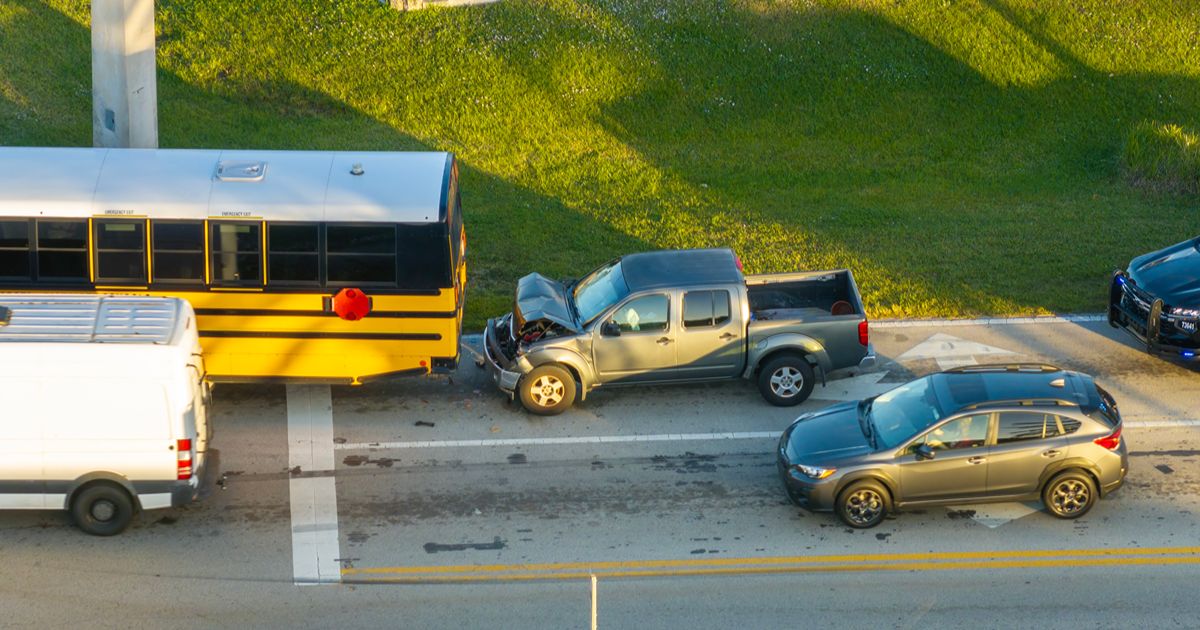
A Fort Lauderdale multi-vehicle pile-up rarely has just one driver at fault.
Florida splits the blame by percentage among every driver who helped cause it.
That split decides how much each insurer owes you.
The hard part is proving the order of the hits, and that proof fades within days.
How Is Fault Split in a Fort Lauderdale Multi-Vehicle Pile-Up?
Fault is split by percentage. A jury assigns a percentage to each driver, and each driver pays only their share.
Under Florida’s comparative fault statute, the court enters judgment against each party based on its own percentage, not under joint and several liability.
One careless driver with thin coverage can leave a hole in your recovery.
The drivers you sue can also blame someone who is not in the case. Lawyers call this a Fabre defendant, after the 1993 Florida Supreme Court case Fabre v. Marin.
A driver who caused the first hit and drove off can still land on the verdict form. Every point of fault given to that missing driver comes off what the others owe you.
Pile-ups are common here. On July 28, 2026, WPLG Local 10 reported that at least eight vehicles crashed in the southbound I-95 express lanes near Sunrise Boulevard, sending three people to the hospital.
According to FLHSMV crash data, Broward County recorded over 16,000 crashes between Jan. 1 and June 24, 2026.
Does the Rear-End Rule Apply if You Were Pushed?
Not automatically. Florida presumes the rear driver in a rear-end crash was negligent.
Since Birge v. Charron in 2013, you can rebut that presumption with evidence that another driver was also at fault. In a chain crash, that matters for every car in the middle.
The Car That Got Shoved
Say you stopped safely on I-595 near the State Road 84 ramps. A car behind you hit hard and pushed you into the car ahead.
You touched that bumper, but you did not cause the crash. Crush damage on both ends of your car helps prove it.
The Driver Who Blames a Sudden Stop
A sudden stop alone does not clear the rear driver. Florida courts look for a stop that was abrupt and in a place drivers would not expect.
Traffic backing up near Broward Boulevard at rush hour is expected.
Section 316.0895 bars following closer than is reasonable for the speed, traffic, and road conditions.
Trucks outside business or residential districts must generally stay at least 300 feet back.
Crash reports often get the order wrong because officers arrive after the cars stop. We have shown that reports aren’t always right.
If a driver was on the job, the employer may share the blame, which often comes up in company vehicle crashes.
Which Impact Caused Which Injury?
This is the fight insurers rarely mention up front. In a pile-up, you may be hit two or three times. Each insurer then argues the other impact caused your herniated disc or concussion.
Tell your doctor how many impacts you felt and from which direction. Head injuries are a special risk, since delayed brain injury symptoms can show up days later and look unrelated.
Florida lets you bring claims against several drivers in one case when the injuries are hard to separate. The evidence that sorts it out includes:
- Event data recorders, which log speed and braking just before impact
- Dashcam and phone video from drivers who stopped
- Traffic camera footage
- Paint transfer and crush patterns on each vehicle
You can see how this works in a multiple-collision case our firm resolved.
Who Pays When the At-Fault Driver’s Insurance Runs Out?
Your own PIP pays first. Florida’s no-fault PIP covers 80 percent of medical bills and 60 percent of lost wages, up to $10,000, no matter who caused the crash.
The 2026 repeal bills, SB 522 and HB 769, died in committee in March 2026.
After PIP, money gets tight. Florida does not require most drivers to carry bodily injury liability coverage.
When the at-fault driver has it, every injured person may be claiming the same small limit. Uninsured motorist coverage can fill that gap.
So can an umbrella policy, which closed a coverage gap in one of our past cases.
Never walk between lanes on I-95 after a crash. In February 2024, a driver who stepped out to help after a six-vehicle crash north of State Road 84 was struck and killed, according to the Florida Highway Patrol.
If no one is hurt and your car can move, section 316.061 says to move it off the road, and moving it does not make you at fault.
If you are hit while standing outside your car, the claim works much like pedestrian injury claims.
Can You Still Recover if You Share Some of the Blame?
Yes, if you are not more than 50 percent at fault. Since March 24, 2023, Florida bars recovery for anyone more than 50 percent at fault for their own harm.
At 50 percent, you recover half. At 51 percent, you get nothing.
That line makes insurers push blame onto you. Expect questions about your following distance, your speed in the rain, and your phone.
Our post on the fault-sharing rule shows the math for riders, and it works the same for drivers.
Most Florida negligence claims must be filed within two years under section 95.11. This applies to crashes in Florida.
If the crash just happened, take the right first steps and speak with a lawyer before giving any insurer a statement.
Talk to a Fort Lauderdale Multi-Vehicle Accident Lawyer Before the Evidence Fades
Pile-up evidence disappears fast.
Cars get fixed, video gets erased, and witnesses scatter.
Write down every impact you felt, save your photos, and call our Fort Lauderdale car accident lawyer team at (954) 913-2273 for a free case review.