A motorcycle accident lawyer in Coral Springs spends most of the case fighting over one number: your percentage of fault.
Since March 24, 2023, Florida law bars you from recovering anything if a jury puts that number above 50 percent.
That rule hits riders harder than drivers, because adjusters start from a quiet assumption that the bike was speeding or weaving.
Here is how the math works, and where riders give away ground without realizing it.
How Florida’s 51 Percent Bar Changes a Coral Springs Motorcycle Claim
The bar is all or nothing. If a jury finds you 50 percent at fault, your damages get cut in half. If it finds you 51 percent at fault, you walk away with zero.
House Bill 837 created that cliff, and it applies to crashes that happened after March 24, 2023.
Compare the two outcomes on a $400,000 claim. At 50 percent fault, you recover $200,000. At 51 percent, you recover nothing at all. One percentage point decides the entire case.
Older crashes still run under Florida’s previous pure comparative rule, where a rider 80 percent at fault still recovered 20 percent.
You can read the current apportionment language in Florida Statute 768.81 on the Florida Senate site.
Because the deadline to file most negligence claims is now two years, waiting to see how you heal can quietly cost you the claim.
Our post on the limited time to sue explains why that clock matters more than people expect.
Does Riding Without a Helmet Count Against You?
Not for causing the crash. Florida Statute 316.211 lets riders 21 and older ride without a helmet if they carry a policy with at least $10,000 in medical benefits for motorcycle injuries.
Riders under 21 must wear one. Eye protection is required for everyone, with no insurance substitute.
What the defense does instead is argue the helmet defense. That argument concedes the driver caused the collision, then claims your head injuries would have been milder with a helmet, so you should absorb part of that harm.
The Florida Bar’s analysis of the helmet defense traces it back to Florida’s seat belt defense, which apportions damages based on the reasonableness of each party’s own conduct.
That distinction matters. The defense must prove a real causal link between the missing helmet and the specific injuries, typically through medical or biomechanical testimony.
A conclusory claim from an adjuster is not proof. Before the 51 percent bar existed, a helmet argument only shaved a claim. Now, stacked on top of a crash-fault argument, it can push a rider over the cliff.
The limit worth naming: the helmet defense reaches head and facial injuries. It has nothing to say about a shattered femur or a crushed shoulder.
Why a Motorcycle Accident Lawyer in Coral Springs Starts With the PIP Gap
Florida PIP does not cover motorcycles. Section 627.736 leaves bikes out of the definition of a motor vehicle, so there is no $10,000 no-fault cushion and no 14-day treatment rule.
Riders pay for early care through health insurance, uninsured motorist coverage, or a letter of protection.
There is an upside most riders never hear. Because motorcyclists sit outside the no-fault bargain, they are not subject to the permanent injury threshold that applies to car occupants.
A rider’s claim for pain and suffering damages starts on day one.
That gap is why I push riders toward stacked uninsured motorist coverage before anything happens.
Roughly one in four Florida drivers carries no insurance or fraudulent insurance. Our breakdown of uninsured motorist coverage covers why the limits you pick today decide what you collect later.
Note that the $10,000 medical benefits policy used for the helmet exemption is not UM coverage and not PIP. Three different things, three different jobs.
The Left Turn Crash and How Fault Gets Argued Here
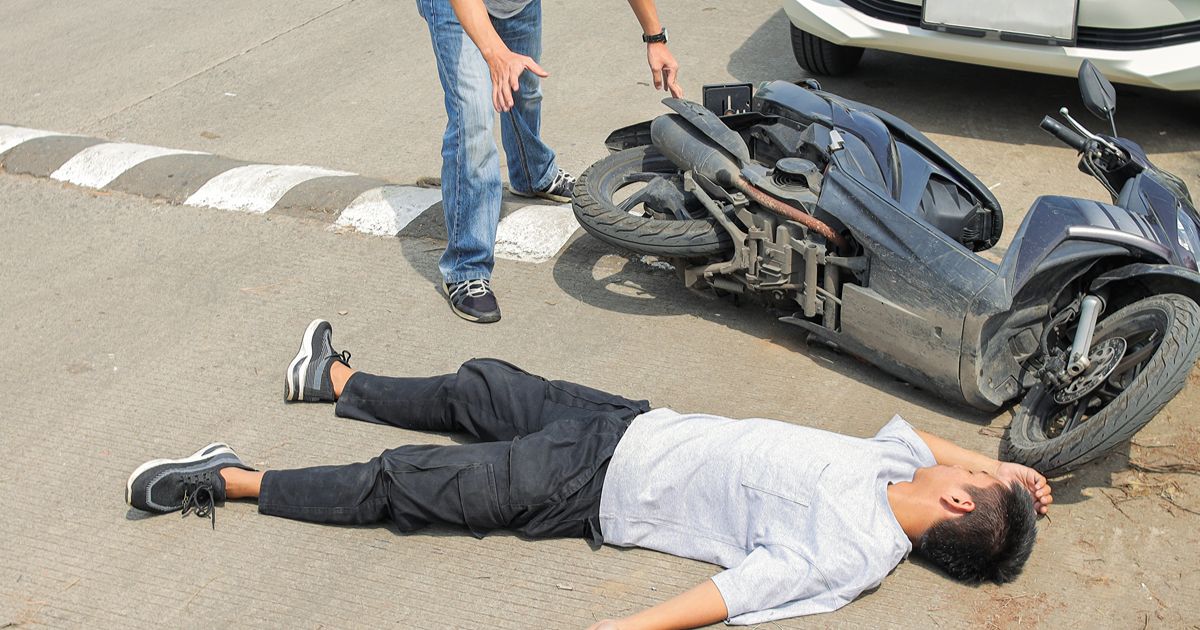
The classic Coral Springs rider case is a left turn. A driver turns across University Drive, Sample Road, or Wiles Road, says, “I never saw him,” and the insurer immediately claims the bike must have been speeding to appear so suddenly.
Speed is the fight. It gets resolved with scene evidence, not opinions: skid and gouge marks, final rest positions, crush damage, signal timing, and nearby business camera footage that gets overwritten in days.
Waiting three weeks to gather that proof is the most common mistake I see riders make, and it hands the insurer an unrebutted speed theory.
If the crash report has the sequence wrong, that is fixable, but it takes work.
Our article on what happens when a crash report is wrong walks through the process.
It also helps to understand the elements behind proving negligence before you talk to anyone.
What Adjusters Use to Push Your Percentage Up
Adjusters build fault out of small admissions.
The most reliable source is your own recorded statement, taken while you are medicated and guessing. “I might have been going about 45” becomes the anchor for the rest of the claim.
There are good reasons to decline a recorded statement until you have advice.
They also lean on lane-splitting claims, which is a real problem because lane splitting is illegal in Florida.
They lean on gear, modifications, exhaust volume, and any gap in treatment. Every one of those is an attempt to move you closer to 51 percent.
Protecting Your Percentage After a Coral Springs Crash
Comparative negligence is not a formality. It is the whole case, decided by evidence gathered in the first few weeks.
If a driver turned in front of you anywhere in Broward County, photograph the scene, get treated, and let someone request the nearby camera footage before it disappears.
A free case review with our Coral Springs injury lawyers costs nothing and starts that clock in your favor.