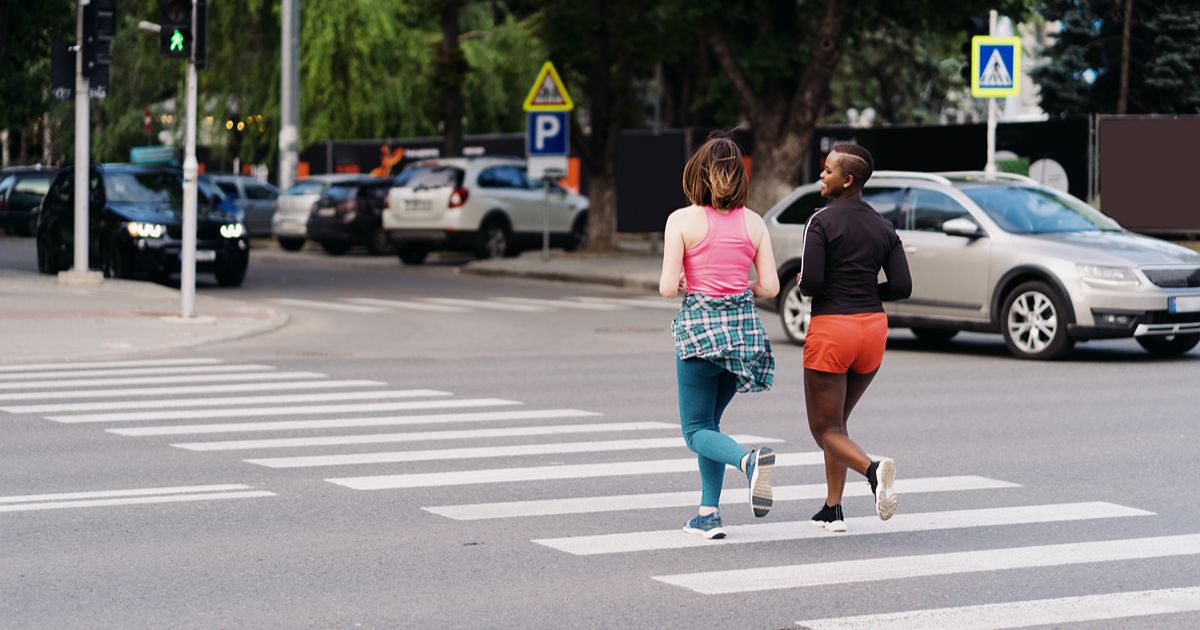
In a pedestrian accident in Coral Springs, the first question an insurer asks is whether you were in a crosswalk.
The answer surprises people. Florida law puts a legal crosswalk at every intersection with sidewalks, painted or not.
So a walker struck at a corner with no stripes, no signal, and no sign often had the right of way, even though the adjuster’s first letter says otherwise.
What Counts as a Crosswalk in Florida, Even Without Paint
Two kinds of crosswalks exist here. A marked crosswalk is any stretch of road striped or otherwise marked for crossing.
An unmarked crosswalk is the space at an intersection between the lateral lines of the sidewalks on opposite sides of the road.
That second category decides many Coral Springs cases. Neighborhood corners along Riverside Drive and Coral Ridge Drive, and the residential feeders off Wiles Road, rarely carry paint.
They are still crosswalks, and the same right-of-way rules apply.
The rule reverses once you leave the intersection. Under Florida Statute 316.130(10), a pedestrian crossing at any point other than a marked or unmarked crosswalk must yield to all vehicles.
Between two adjacent signalized intersections, you have to use a marked crosswalk.
Those two lines are where genuinely difficult cases live, and they are worth reading in the current text of Florida Statute 316.130.
Who Is Liable When There Is No Signal or Sign
The driver is liable in most uncontrolled crosswalk collisions.
Where no signal or sign is in place, the statute requires the driver to yield the right of way, slowing down or stopping as needed, to a pedestrian in the crosswalk on the driver’s half of the road or approaching so closely from the opposite half that the driver is in danger.
Liability is not automatic, though, and this is the limit I want people to hear.
Section 316.130(8) says a pedestrian may not suddenly leave a curb and step into the path of a vehicle that is too close to stop.
Defense lawyers build entire cases on that one sentence. Video, phone records, and lighting conditions usually settle whether a step was sudden or ordinary.
Coral Springs also has a recurring design problem. Long blocks along University Drive and Sample Road leave big gaps between signals, so people cross where crossing makes sense rather than where the paint sits.
Our breakdown of the most dangerous intersections in the city maps out where that pattern repeats.
The Multiple Threat Crash on Multi-Lane Roads
One crash type accounts for a large share of serious injuries on wide suburban roads. A driver in the curb lane stops for a pedestrian.
The pedestrian steps out from behind that stopped vehicle. A driver in the next lane, whose view is blocked, keeps moving and strikes them.
Florida law already addresses this. Section 316.130(9) says that when a vehicle is stopped at a marked or unmarked crosswalk to let someone cross, an approaching driver may not overtake and pass that stopped vehicle. The passing driver is frequently the party who broke a written rule, not the pedestrian.
I raise it because insurers reflexively blame the walker in these cases.
The stopped car is the evidence that makes the difference, and identifying that driver in the first days matters.
The seven steps after a crash apply just as much when you were on foot.
How Comparative Fault Reshapes a Pedestrian Accident in Coral Springs
Fault is measured as a percentage, and a single number ends the case. Since March 2023, a claimant found more than 50 percent responsible under Florida Statute 768.81(6) recovers nothing.
At 50 percent or below, the award drops by the assigned share.
Adjusters know this and work the margins. Dark clothing, a phone in your hand, earbuds, a crossing angle that is not perpendicular to the curb, and any alcohol reading all contribute to pushing the number upward.
None of those facts end a claim by itself. Together, and unanswered, they can.
The counterweight is usually physical evidence. Point of impact, throw distance, vehicle damage location, and signal timing tend to tell a more reliable story than either driver’s memory.
That evidence also drives value, which is why maximizing your recovery starts with preservation, not negotiation.
Which Insurance Pays When You Were Walking
Your own auto policy usually pays first. Florida PIP follows the person, so if you own an insured vehicle, that policy covers you when a car strikes you on foot.
If you do not own a vehicle, a resident relative’s PIP may apply, and if neither exists, the at-fault vehicle’s insurer may owe those benefits.
PIP caps out at $10,000 for most people and pays no compensation for pain and suffering.
Pedestrian injuries blow through that figure quickly, especially head injuries. Anyone dealing with the aftermath of a traumatic brain injury learns that fast.
The real recovery comes from the driver’s bodily injury liability coverage, or from your own uninsured motorist coverage when the driver has none.
A refresher on Florida auto insurance coverage is worth the ten minutes before you ever need it.
When a child is the one struck, different timing rules and damage categories apply, which we cover in our article on when a child is hit.
If you are unsure how to start a claim after being hit while crossing the street, talk to a lawyer before you give any statement.
What Decides an Uncontrolled Crosswalk Case
These claims turn on geometry and timing, not on who sounds more sympathetic.
Where the intersection lines intersect, where the impact occurred, and how far the vehicle traveled after braking determine the percentages.
If you were struck at a Coral Springs corner without a signal, photograph the location from both approaches, get treated the same day, and let our Coral Springs injury lawyers request the nearby camera footage before it cycles out.
The Florida Department of Highway Safety and Motor Vehicles also publishes plain-language pedestrian safety guidance worth reading.